California AB 1263: What Firearms Retailers Need to Know About the New Accessory Law
Assembly Bill 1263 takes effect January 1, 2026, creating new age verification and compliance requirements for selling firearm accessories to California residents. Complete guide for retailers.

California's firearms landscape is about to change significantly. Assembly Bill 1263, signed into law on October 11, 2025, introduces new requirements for retailers selling firearm accessories to California residents. With the law taking effect on January 1, 2026, many retailers are scrambling to understand their compliance obligations.
If you sell firearm parts, accessories, or manufacturing equipment to California customers, here's what you need to know.
What is AB 1263?
Assembly Bill 1263, officially titled "Firearms: ghost guns," significantly expands California's regulation of firearm-related products beyond complete firearms. While the law's stated goal is to address concerns about unserialized "ghost guns," its scope extends far beyond that, affecting everyday firearm accessories and parts.
The law amends California's Firearm Industry Responsibility Act (FIRA) and creates new requirements for anyone selling what California defines as "firearm accessories" or "firearm manufacturing machines" to state residents.
Who Does AB 1263 Affect?
You're affected if you:
- Sell firearm accessories online to California customers
- Ship firearm parts to California addresses
- Operate an e-commerce store selling gun-related products
- Are located outside California but serve California residents
This includes:
- Online retailers and marketplaces
- Out-of-state gun stores with e-commerce
- Parts manufacturers selling direct-to-consumer
- Accessory vendors on platforms like eBay (though many have stopped CA sales)
The law applies regardless of where your business is located. If you're shipping to California, you're subject to AB 1263.
What Products Are Covered?
AB 1263's definition of "firearm accessory" is broad and includes:
Rate-of-Fire Modifying Items:
- Trigger modifications
- Bump stocks and similar devices (already prohibited)
- Speed loaders and reloading aids
Magazine-Related Items:
- Magazines of any capacity
- Magazine loaders
- Magazine release mechanisms
Assault Weapon Features (Per Penal Code § 30515):
- Pistol grips and foregrips
- Folding, telescoping, or thumbhole stocks
- Flash suppressors
- Threaded barrels
- Shrouds and handguards
Manufacturing-Related Items:
- 80% lower receivers and jigs
- CNC machines marketed for firearm production
- 3D printers advertised for firearm manufacturing
- Parts sets designed for firearm assembly
Additionally:
- Standalone firearm barrels (subject to both AB 1263 and SB 704)
- Triggers, barrels, slides, and similar components
If you're unsure whether your products fall under these definitions, err on the side of caution. The California Department of Justice has authority to issue additional clarifying regulations.
The Four Compliance Requirements
AB 1263 creates four mandatory requirements before completing any sale or delivery to California residents:
1. Age and Identity Verification
Requirement: Verify the purchaser is at least 18 years old using government-issued photo identification.
What this means:
- Driver's license, state ID, passport, or military ID required
- Must confirm identity matches the ID
- Cannot rely on customer's word or honor system
- Must verify before completing the sale or delivery
Acceptable verification methods:
- Real-time ID authentication systems
- Manual review of uploaded ID photos
- Third-party age verification services
2. Provide Legal Notice
Requirement: Display clear and conspicuous notice informing customers about California's firearm manufacturing restrictions.
The notice must inform customers it's a crime in California to:
- Manufacture more than 3 firearms per year without a license
- Manufacture firearms using 3D printers or CNC machines without a license
- Manufacture firearms for sale to unlicensed individuals
- Manufacture firearms to sell without required background checks
- Aid prohibited persons in manufacturing firearms
- Manufacture assault weapons, machine guns, unserialized firearms, or unsafe handguns
Implementation: Most retailers display this notice during checkout with a clear acknowledgment mechanism.
3. Collect Acknowledgment
Requirement: Obtain written (or digital) acknowledgment that the customer received and understands the legal notice.
What this means:
- Customer must actively acknowledge (checkbox, signature, click-through)
- Cannot be buried in general terms and conditions
- Must be specific to AB 1263 requirements
- Must be retained for audit purposes
Best practice: Implement a dedicated acknowledgment step in your checkout flow with clear, unambiguous language.
4. Address Matching and Signature Requirements
Requirement: Ensure proper shipping and delivery procedures.
Shipping requirements:
- Package labels must state: "Signature and proof of identification of person aged 18 years or older required for delivery"
- Shipping address must match the address on the customer's ID
- Adult signature required upon delivery
- Courier must verify ID at delivery
Implementation challenges:
- Not all carriers support detailed ID verification at delivery
- Address matching can be complex (apartments, work addresses, etc.)
- Some retailers are limiting California sales due to carrier limitations
Timeline and Effective Date
Key Dates:
- October 11, 2025: Governor Newsom signed AB 1263 into law
- January 1, 2026: Law takes effect (ALREADY IN EFFECT)
- Ongoing: California DOJ may issue additional implementing regulations
If you're reading this after January 1, 2026, you should already be in compliance. Sales made after this date without proper verification and acknowledgment procedures violate the law.
Penalties for Non-Compliance
AB 1263 violations carry serious consequences:
Civil Liability:
- Violations are civilly actionable under FIRA
- Private lawsuits allowed (individuals can sue directly)
- Potential injunctive relief (court orders to change practices)
- Compensatory damages
- Attorney's fees
Increased Exposure:
- FIRA creates strict liability for certain violations
- No intent required for civil penalties
- Retailers can be liable even if products are later misused
Practical Impact:
- Legal defense costs, even if you win
- Reputational damage
- Potential loss of payment processing or merchant accounts
- Business disruption
The law does not specify criminal penalties for verification failures, but civil exposure alone is significant enough to warrant immediate compliance efforts.
Exemptions
AB 1263's requirements do NOT apply to sales or deliveries to:
- Federally licensed firearms dealers (FFLs)
- Licensed ammunition vendors
- Armed Forces or National Guard members (on duty, within scope of employment)
- Law enforcement officers (on duty, within scope of employment)
- Forensic laboratories
- Wholesalers
- Licensed common carriers (during transportation)
If your business primarily serves other FFLs or law enforcement, your compliance burden is significantly reduced.
What Retailers Are Doing
The firearms industry has responded to AB 1263 in several ways:
Compliance Efforts:
- Implementing ID verification systems at checkout
- Adding AB 1263 acknowledgment steps
- Requiring adult signatures on all California shipments
- Working with carriers to improve delivery verification
Market Exit:
- Some retailers have stopped shipping to California entirely
- Major marketplaces like eBay struggle to implement verification
- Small retailers find compliance costs prohibitive
Hybrid Approaches:
- Limiting California sales to specific product categories
- Requiring FFL transfers for all California sales (even non-firearms)
- Manual order review for every California shipment
Technology Solutions:
- Third-party identity verification services (like ZeroTrust)
- Integrated checkout verification flows
- Automated address matching systems
Steps Retailers Should Take Now
If you haven't already implemented AB 1263 compliance, here's your action plan:
Immediate Actions (This Week):
- Review your product catalog
- Identify which products fall under AB 1263
- Flag California-restricted items in your inventory system
- Implement temporary measures
- Consider manual verification for California orders
- Add legal notices to your checkout process
- Update shipping procedures
- Evaluate your options
- Continue serving California customers with proper compliance
- Exit the California market
- Require all California sales through FFLs
Short-Term Actions (Next 2-4 Weeks):
- Select a compliance solution
- Identity verification service
- Manual review process
- Third-party compliance platform
- Update your checkout flow
- Add age verification step
- Display AB 1263 legal notice
- Collect acknowledgments
- Implement address matching
- Train your team
- Order fulfillment staff
- Customer service representatives
- Compliance officers
- Document your procedures
- Written compliance policy
- Record retention procedures
- Audit trail processes
Ongoing Compliance:
- Monitor for updates
- California DOJ may issue clarifying regulations
- Industry best practices will evolve
- Legal challenges may clarify requirements
- Maintain audit trails
- Keep verification records (minimum 3 years recommended)
- Document acknowledgments
- Log all California transactions
- Review quarterly
- Compliance procedure effectiveness
- Verification success rates
- Customer feedback and pain points
Related California Laws
AB 1263 doesn't exist in isolation. Be aware of related requirements:
Senate Bill 704 (Firearm Barrels):
- Effective January 1, 2026
- Requires all standalone barrel sales go through California FFLs
- Background check required starting July 1, 2027
- Direct-to-consumer barrel shipments prohibited
Assembly Bill 1078 (Purchase Limits):
- Creates 3-per-30-day firearm purchase limit
- Replaced previous 1-per-30-day limit after court ruling
Existing California Regulations:
- California Firearms Roster (handguns)
- Assault weapon restrictions
- Large-capacity magazine prohibitions
- Ammunition purchase requirements
Understanding the full regulatory landscape helps ensure comprehensive compliance.
Industry Resources
California Rifle & Pistol Association (CRPA):
- Detailed AB 1263 guidance bulletin
- Sample acknowledgment forms
- FFL finder tools
- Legal support resources
National Shooting Sports Foundation (NSSF):
- Compliance webinars
- Industry working groups
- Best practices documentation
Firearms Policy Coalition (FPC):
- Legal challenges and updates
- Advocacy efforts
California Department of Justice:
- Official regulations and guidance
- Contact: https://oag.ca.gov/firearms/contact
The Bottom Line
California AB 1263 represents a significant expansion of regulation beyond firearms themselves to encompass accessories, parts, and manufacturing tools. While compliance adds friction to the sales process, the penalties for non-compliance are too severe to ignore.
Retailers serving California customers have three realistic options:
- Implement full compliance - Invest in verification systems, update processes, and continue serving the California market
- Exit the California market - Stop shipping to California addresses entirely
- FFL-only sales - Require all California sales go through licensed dealers
The right choice depends on your business model, California sales volume, and resources available for compliance implementation.
For retailers choosing compliance, the key is acting now. The law is already in effect, and every day of non-compliance increases your exposure to civil liability.
Need Help with AB 1263 Compliance?
ZeroTrust provides identity verification specifically designed for e-commerce compliance needs. Our system handles age verification, ID authentication, and provides the audit trail required for AB 1263 compliance.
Learn more: www.entrinsia.com/solutions/ab1263
Disclaimer: This article provides general information about California AB 1263 and should not be construed as legal advice. For specific guidance on your compliance obligations, consult with an attorney familiar with California firearms law. The information in this article is current as of January 7, 2026, but regulations may change.
About Entrinsia: Entrinsia provides identity verification and compliance solutions for regulated industries. Our ZeroTrust platform helps e-commerce businesses meet age verification requirements while minimizing data liability.
Related Articles
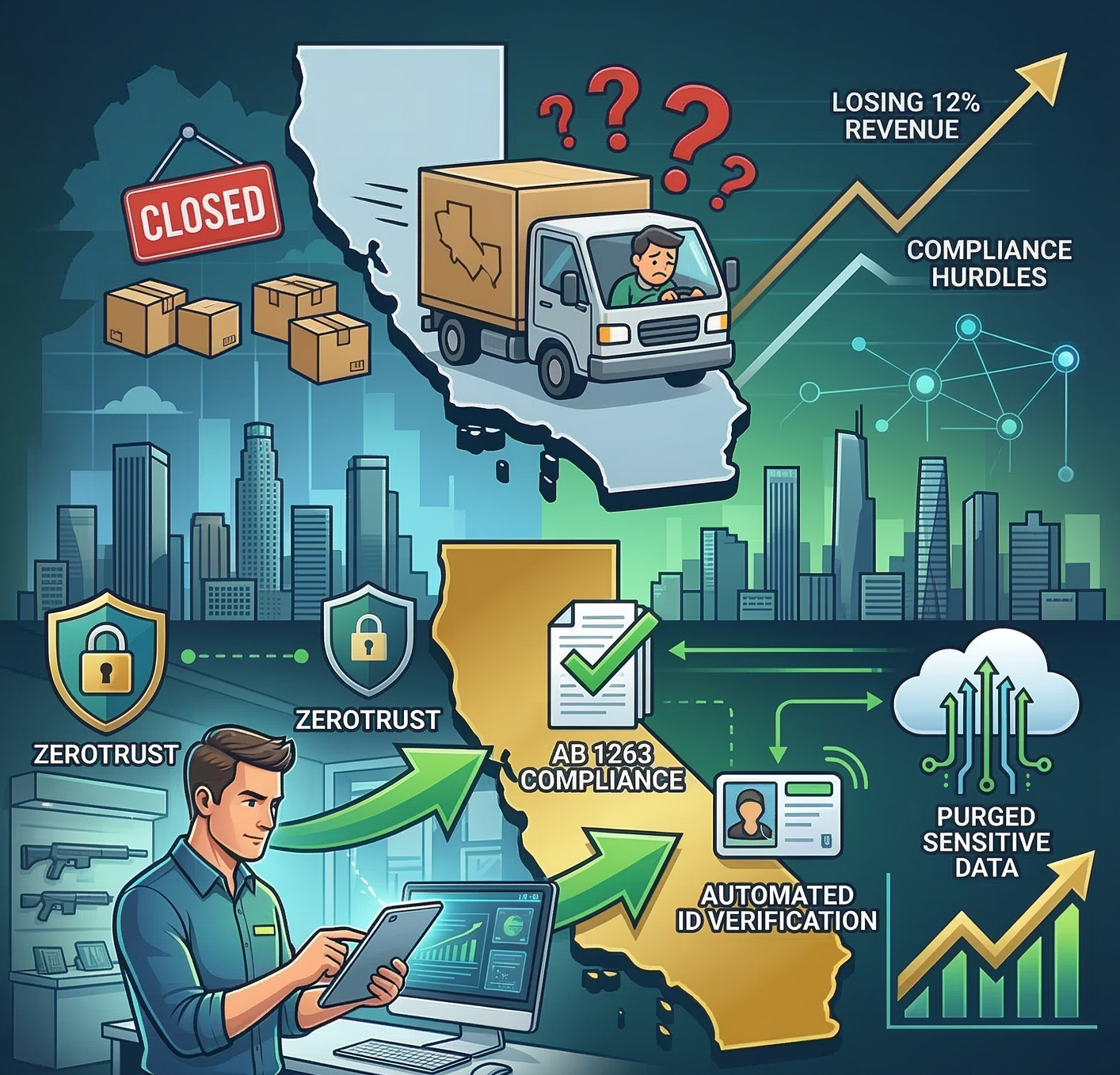
The California Exit vs. The California Strategy: Why Firearm Retailers are Doubling Down in 2026
While competitors flee the state, the "California Strategy" transforms AB 1263 compliance into a massive market opportunity for firearm retailers. Using Entrinsia’s ZeroTrust architecture, you can automate ID verification and purge sensitive data to stay audit-ready without losing 12% of your revenue. Do not retreat—reinforce your business by turning regulatory hurdles into a competitive advantage.

Identity Verification: From Nice-to-Have to Business Critical
What changed? Identity verification has shifted from an optional safety feature to a business requirement. Learn why companies across every industry now face mounting pressure to verify users.

Why Common Age Verification Methods Fail (And What Actually Works)
Credit cards, social logins, and email verification seem like easy solutions for age verification—but they do not satisfy legal requirements and leave your platform exposed. Learn what actually works.